
–
Digital single to be released on June 19th, 2026.
To purchase, head to our Bandcamp page.
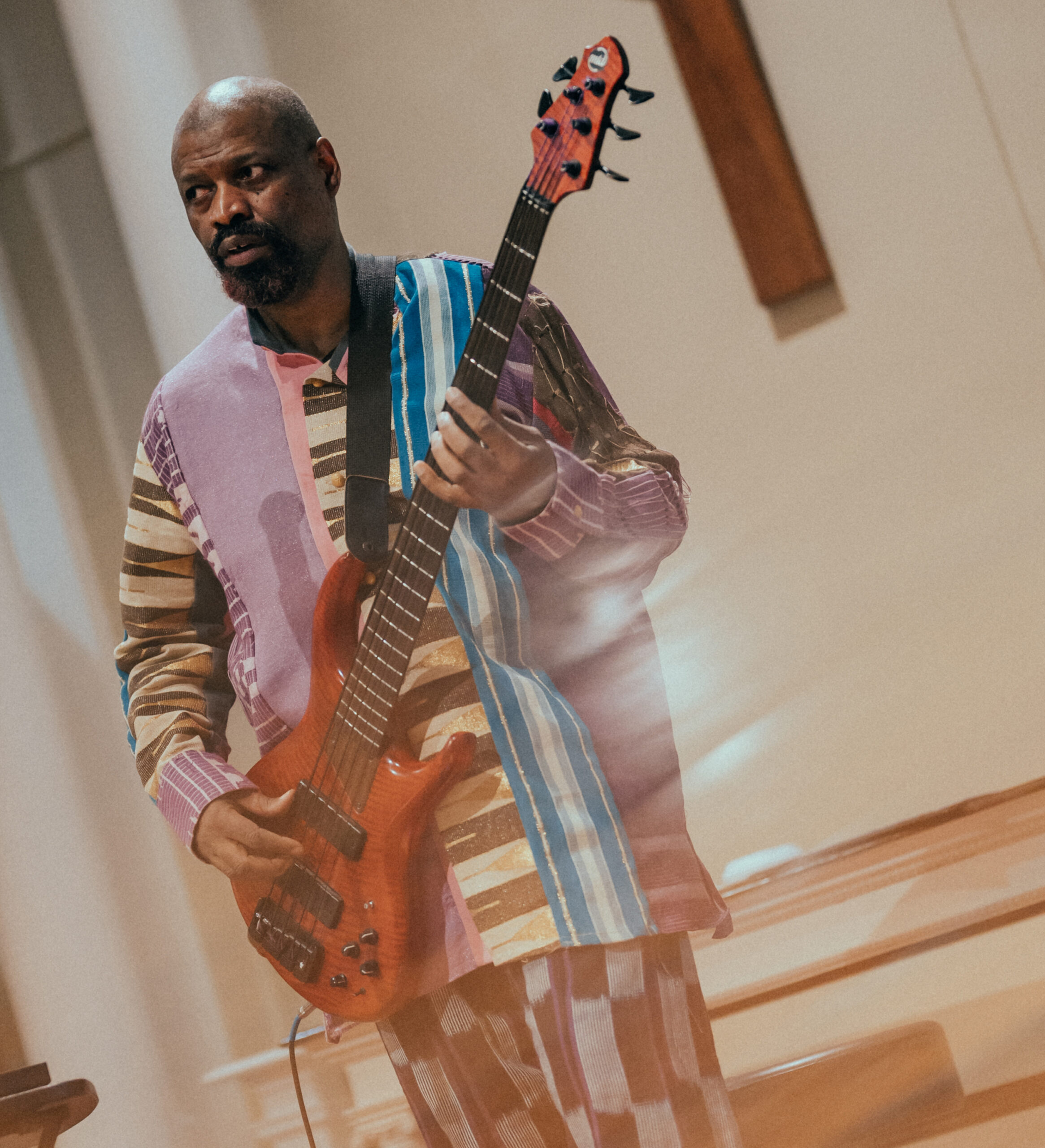
Grammy-nominated composer / producer / bassist Melvin Gibbs has a beyond-diverse background in jazz, rock, punk, and freeform experimentalism — anchored by mentors including Ornette Coleman and Gil Evans, encompassing work with Arto Lindsay, dead prez, and Sonny Sharrock, stints in Defunkt and the Rollins Band, and collaborations in ensembles including Power Tools alongside Bill Frisell and Ronald Shannon Jackson and the cooperative Harriet Tubman. Within the last few years, Gibbs released solo works on Editions Mego and Northern Spy, and performed in collaboration with Marshall Allen, Elliot Sharp, Don McKenzie (as Bootstrappers), Wadada Leo Smith, and with theoretical physicist Dr. Stephon Alexander (as God Particle). Gibbs plays bass in the band Body Meπa, whose two albums to date – 2021’s The Work Is Slow (HAUSMO120) and 2024’s Prayer in Dub (HAUSMO145) – were released by Hausu Mountain.
In 2025, Gibbs released Amasia: Anamibia Sessions 2 on Hausu Mountain, which found him assuming the roles of producer, bandleader, editor, and performer, compositing contributions from a wide cast of collaborators including Pete Cosey, Greg Fox, Chris Williams, John Medeski, and many more into temporally reunified and meticulously collaged productions of electronic-infused free-jazz experimentation. The album continued a series of LPs that began with Anamibia Sessions 1: The Wave, issued on legendary label Editions Mego in 2022.
Melvin Gibbs’s first book, titled How Black Music Took Over The World, was published by Basic Books in April 2026, and received praise from Publishers’ Weekly as “a stimulating take on the complexities and influence of a rich and multifaceted musical tradition” and from The Wire Magazine as “a homage to the many friends, mentors, and collaborators who have handed down their often hard won knowledge […] that deserves to be given due time and attention.”
Gibbs returns to Hausu Mountain with the single “Lift Every Voice and Sing” – his first new recording to be released after the publication of his first book, presented in concert with the central themes and overlapping personal histories that he explores in his writing and his scholarship. For the single’s artwork, Melvin Gibbs selected a photograph of his father Rufus Gibbs Jr. holding him on a New York City sidewalk as a baby.
In Gibbs’s own words:
“My Anamibia Sessions records are based around electronics, sound design, and sound manipulation. And the music, overtly on Anambia Session 1: The Wave, and covertly on Amasia: Anamibia Sessions 2, has been highly conceptual. To balance that out, I wanted to drop something that really got to the point, something that is just about the song and what I bring to the table as a bassist.
This solo electric bass arrangement of “Lift Every Voice And Sing”, the song written by the brothers James Weldon and J. Rosamond Johnson that the NAACP officially declared “the Negro National Anthem” in 1919, was commissioned by the National Society of Black Physicists. I first performed the piece at the opening of their 2019 conference. I’ve played it at my solo performances since then. My thinking was that I’d hold off releasing a recording of it until I dropped an album that was solely solo electric bass pieces. But the discussions I’ve had in wake of the release of my book How Black Music Took Over The World prompted me to release something under my own name that points directly to the musical heritage of Black Americans. So I’ve decided to record and release my arrangement of the Negro National Anthem now.”
In How Black Music Took Over the World, Melvin Gibbs analyzes the power that has led Black music to define the sound of global culture and resonate across styles, borders, and generations, tracing it back to its roots: the musical inheritance of Africa. Beginning with two rhythmic building blocks he calls the “cell” and the “frame,” Gibbs shows how these patterns transport listeners to “a realm where sounds become vehicles for human movement.” Reforged across the African diaspora, from church organs and electric guitars to computers, telephones, to a simple gourd, these sounds form the foundation of global popular music: rock, hip hop, country, pop, dance, and even K-pop. Black musicians are the “scientists of sound,” and the sonic elements they developed are the ingredients that music creators all over the world now use.
Drawing from his life in music— the 1980’s punk funk scene of New York City to sessions with jazz legends, Brazilian pop stars, and Senegalese drummers — Gibbs unites lived experience with deep insight to offer a practitioner’s perspective on Black music and its innovations. Whether he’s exploring Kendrick Lamar’s Super Bowl performance, Beyoncé’s Cowboy Carter, or the cosmic vibration that links rhythm, sound, and life, How Black Music Took Over the World reveals how Black music continues to shape, and inspire, the modern world.