–
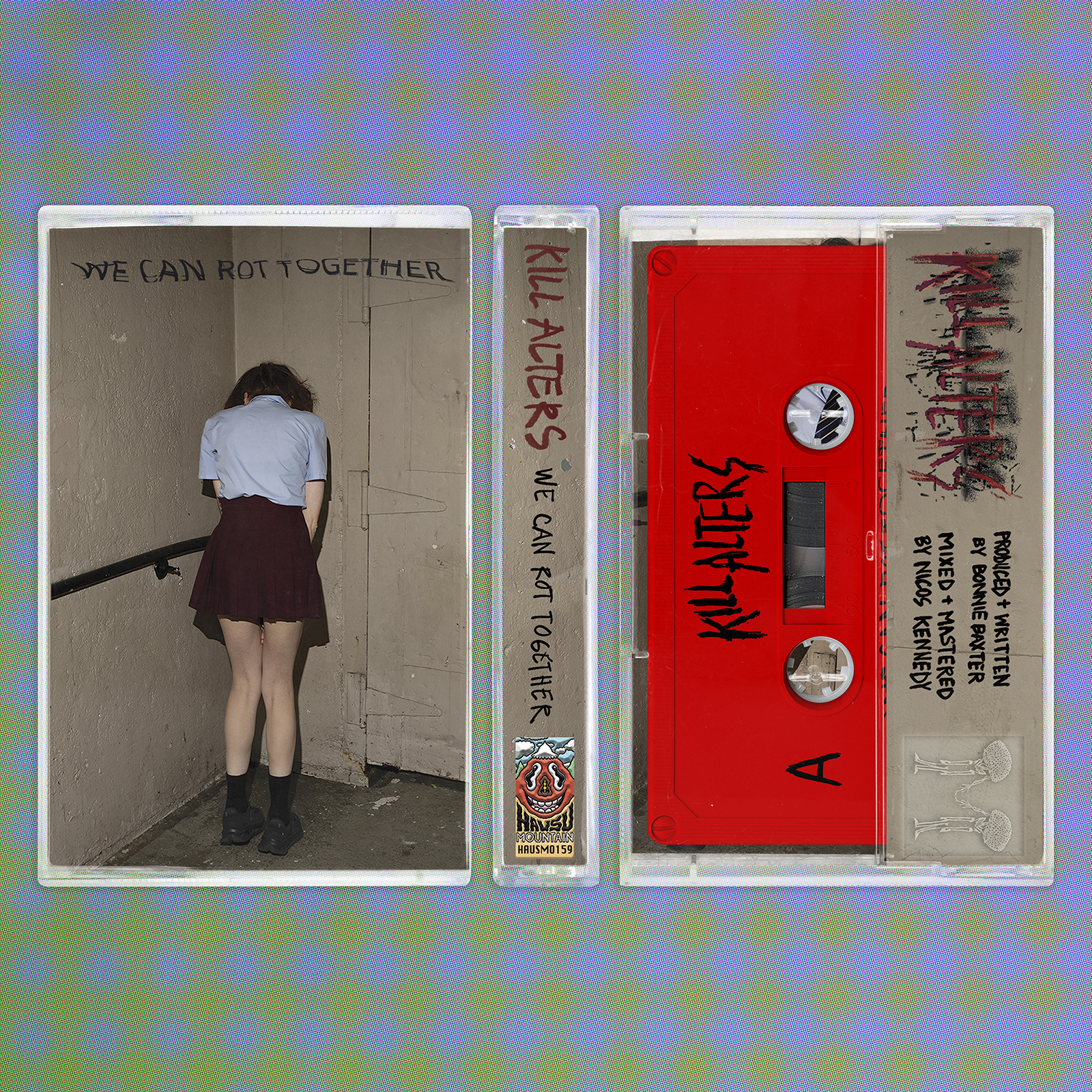
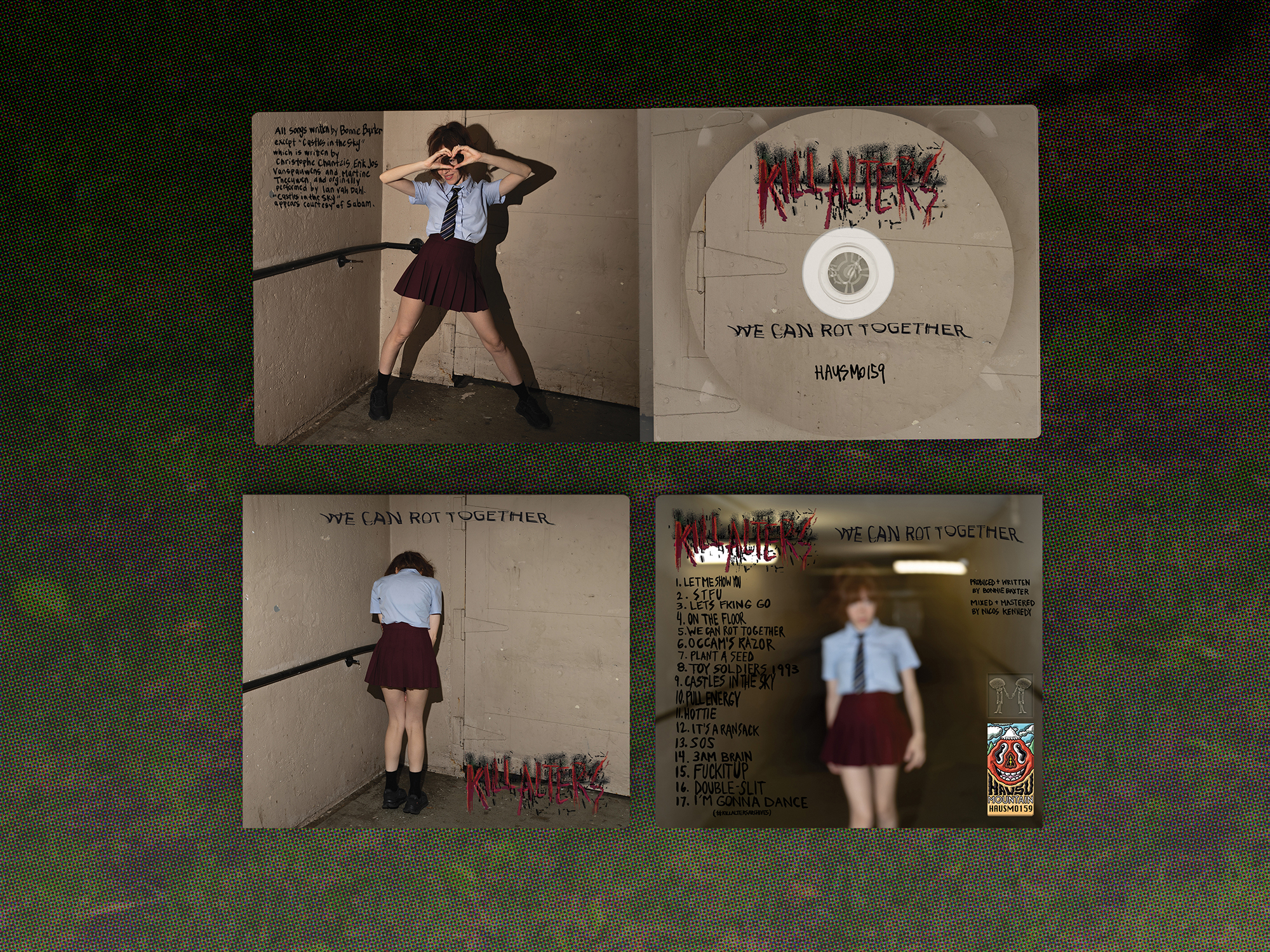
To be released on Tape and CD on October 16th, 2026. C50 – red tape with black imprints packaged with a 2-sided 4-panel J-Card. CD packaged in 4-panel gatefold digipak. This is the catalog page with album information and artwork. To purchase, head to our Bandcamp page.
–
–
Kill Alters returns to Hausu Mountain with We Can Rot Together, the project’s third album in the label’s catalog following Armed to the Teeth L.M.O.M.M. (HAUSMO125, 2022) and No Self Helps (HAUSMO61, 2017). Spearheaded by Bonnie Baxter since the project’s inception, Kill Alters has previously featured drummer Hisham Bharoocha (Lightning Bolt, Black Dice, Boredoms) and Baxter’s husband Nicos Kennedy (a frequent collaborator of Machine Girl, Femtanyl, and Lustsickpuppy) as performing band members. In its most recent configuration, Kill Alters has shifted to focus on Baxter as the composer, producer, and lead vocalist propelling her ballistic solo work from a command center of hardware and software instruments – with Kennedy handling the mixing and mastering of Baxter’s music. Bonnie Baxter’s work has appeared in the HausMo catalog on two solo albums under her given name, and on five releases as half of the duo Prolaps with Machine Girl’s Matt Stephenson. On We Can Rot Together, Baxter offers us a thrilling program of her most direct and dancefloor ready bangers under the Kill Alters umbrella to date as she channels energy from various flavors of 90s-to-Y2K-era rave music. She has honed her practice both as a sculptor of polyrhythmic webs of technoid electronics and as a frontwoman shapeshifting on a dime through diverse vocal styles and personas. As with all Kill Alters music, Baxter weaves archival recordings of her own childhood and her upbringing with her mother into the chaos of We Can Rot Together – yet the tenor of these diaristic flashes has shifted from cathartic self-examination into the realm of celebration. As we hear flashes of Baxter singing karaoke as a child and her mom brashly proclaiming “I’m gonna dance,” we get in the spirit with them; we get on the floor and we headbang to the sounds that Baxter has conjured for us.
Though elements of the cybernetic digi-hardcore of Kill Alters’ previous output still animate We Can Rot Together, Baxter’s production foregrounds a foundation of mutated house, trance, and techno – all styles that informed her musical development as a teenager, just as they continue to inspire a wide cross-section of pop and dance music today. The album throbs with four-on-the-floor kick patterns and jittering saw wave synth lines, squelching acid basslines and synthetic orchestral stabs. Baxter primarily crafted her rapidly shifting productions with an iOS interface called Patterning. The software allows her to lay out a menu of beat-synced patches of synths and drum programming that she can trigger at a touch, resulting in polyrhythmic spreads of sound that surge in intensity as she piles on the layers. She describes her on-the-fly production as an intuitive compositional style that lets her respond to sounds in the moment and sketch out tracks based on emotional instincts. By sampling her own voice and threading it into the din using the same program as her production elements, the line between Baxter as producer and Baxter as vocalist vanishes, giving way to a sense of out-of-body rave abandon. When she covers Ian Van Dahl’s 2002 trance anthem “Castles in the Sky” at the album’s midpoint, replicating the original’s production on an era-appropriate Electribe EMX-1 drum machine, the song blends perfectly into its surroundings, its euphoric pop toplines and zigzagging arpeggios urging us to drop out of time and into the zone. As Baxter peppers her lyrics with quotes from 90s dance-pop hits alongside her own surreal wordplay, the feeling of eras colliding and time folding onto itself thickens, as if We Can Rot Together were an unmarked cassette you found in an alley whose provenance you can’t quite pin down even after popping it into the tape deck.
Bonnie Baxter envisioned We Can Rot Together as an auditory incarnation of the constant deluge of information and digital detritus that washes over us as we interact with the internet and the modern world at large. As her voice shifts between registers, at times rising into chirped chipmunk melodies or sinking into demure spoken-word proclamations, we feel as if we’re being led through a dystopian landscape by a disembodied iOS avatar. The fast-chopped clatter of her vocal lines speeds by us like a barrage of memes and short form videos on the feed, with catchphrases like “let’s fucking go!” and “get your ass on the floor!” repeating as spammed mantras à la high-BPM dance styles like footwork or Jersey club. As Baxter’s lyrics veer into more overtly sexual or scatological territories, recalling the profane jock jams of her work with Machine Girl’s Matt Stephenson as Hausu Mountain mainstay duo Prolaps, it feels like we’ve wandered into the seedier quadrants of the web that can’t help but spill over into our daily experience. Baxter wants to make it clear that her goal with We Can Rot Together isn’t to “make a panacea for these dark days,” as we’ve heard so many times before, but rather to lean into the senseless humor of that darkness. Her music reflects the absurdity of the “brain rot” that encroaches on our too-plugged-in society, and she channels the signifiers of those mind-melting media forms to create a parallel escape into rot of her own devising. We might all be worn down by infinite stimuli, but it feels better when we stare into the digital abyss together.
—
—